

The Role of Natural Language Processing in Lyric Analysis
Sentiment and Tone Detection
Structural and Rhyme Scheme Analysis
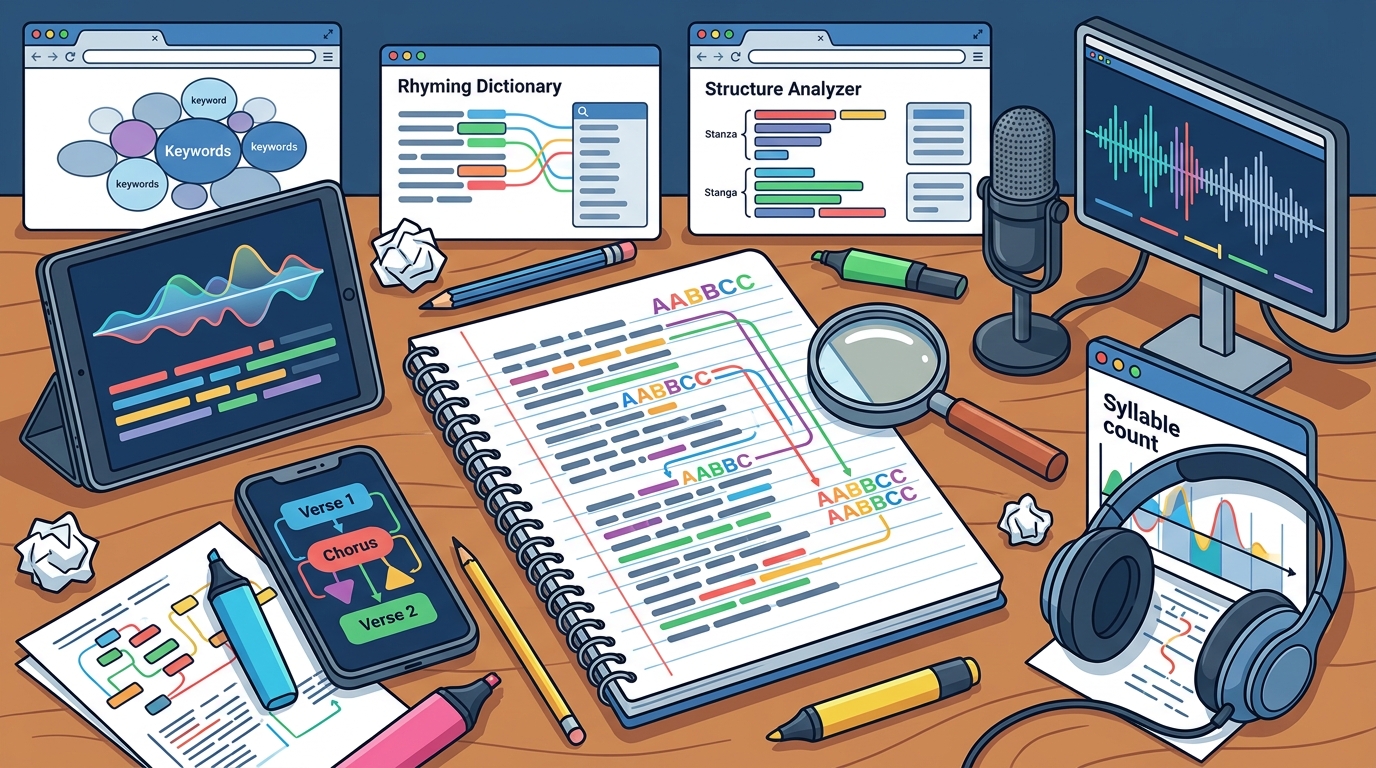
Lyric structure is the backbone of a song, and free tools can help visualize this architecture. A rhyme scheme is the pattern of end rhymes in a poem or song, often denoted by letters like AABBCB. Many free web-based tools allow you to paste your lyrics and will automatically identify these patterns. This is crucial for ensuring that your flow is consistent and that the rhythm supports the melody. If a tool identifies a broken rhyme scheme in a section you intended to be tight, it serves as a clear signal to revisit that part of the writing. For additional details, review the Frequently Asked Questions.
Identifying Flow and Rhythm
Flow refers to the rhythmic delivery of lyrics, and while it is often subjective, some tools attempt to quantify it by analyzing syllable counts and stress patterns. By looking at the distribution of syllables per line, you can identify if certain bars are overloaded with words, which might make them difficult to sing or rap. This analysis is particularly helpful for artists who work with complex time signatures or rapid-fire delivery, ensuring that the technical execution matches the creative vision. For additional details, review the About.
Integrating Analysis into the Creative Process
Using these tools is not about letting the software write for you, but about using it as a feedback loop. When you are working on a project like the 365 Days of Light and Dark, where each entry is a preserved moment, having an objective analysis can help maintain consistency across a large body of work. You can use the data to ensure that your thematic elements are distributed evenly and that the emotional journey of the album or EP is coherent. This integration of technology and artistry allows for a more polished final product.
Practical Workflow for Artists
A practical workflow involves drafting your lyrics, running them through a sentiment analyzer, and then checking the rhyme scheme with a structural tool. If the sentiment data shows a mismatch with your intended mood, you can adjust the vocabulary. If the rhyme scheme is inconsistent, you can tweak the end words. This iterative process helps in refining the lyrics until they meet both your artistic standards and the technical requirements of the genre.
Limitations of Free Tools
It is important to recognize that free tools have limitations. They may struggle with slang, neologisms, or highly abstract poetry, which are common in modern music. The algorithms are trained on standard language, so they might misinterpret creative liberties. Therefore, the analysis should always be taken with a grain of salt and used as a starting point for further human review. The goal is to enhance your understanding of the text, not to let the algorithm dictate your artistic choices.
Choosing the Right Tool
Key Takeaways
- Free apps use NLP to analyze sentiment, rhyme schemes, and structural patterns in lyrics.
- Sentiment detection helps map the emotional arc of a song to ensure it matches the intended mood.
- Rhyme scheme analysis tools can identify inconsistencies in end rhymes, aiding in flow refinement.
- Flow analysis often involves syllable counts and stress patterns to assess rhythmic delivery.
- These tools should be used as a feedback loop in the creative process, not as a replacement for human intuition.
- Free tools may struggle with slang or abstract poetry, so results should be reviewed critically.
- Combining multiple tools can provide a more comprehensive analysis of meaning and flow.
Frequently Asked Questions
Can free apps really understand the meaning of lyrics?
Free apps can identify surface-level meanings and emotional tones using NLP, but they do not understand deep context or abstract concepts. They are best used for structural and sentiment analysis rather than deep semantic interpretation.
What is the best free tool for rhyme scheme analysis?
Do these tools work for all genres of music?
How can I use sentiment analysis to improve my lyrics?
You can use sentiment analysis to check if the emotional tone of your lyrics matches your intent. If the data shows a mismatch, you can adjust your word choices to better align with the desired mood.
Are there any mobile apps for lyric analysis?
Can I use these tools for poetry as well as song lyrics?
Yes, many of the same tools used for song lyrics can be applied to poetry. The principles of sentiment and structural analysis are applicable to both forms of writing.
How often should I run my lyrics through these tools?
It is best to run your lyrics through these tools during the drafting and revision stages. This allows you to catch issues early and make adjustments before the final recording.